A core pillar of Virelion , computational target prioritization for cardiac regeneration.
Cardiac regeneration will not be solved by a single modality. Alongside gene therapy (VB-101) and scaffold/biomaterials (VB-204), Virelion treats protein and drug discovery as a first-class computational program: identify which molecular targets and intervention classes deserve experimental spend, document why, and keep claims bounded.
Compute first. Lab second. Research-stage only , not an approved drug, not a clinical pipeline product.
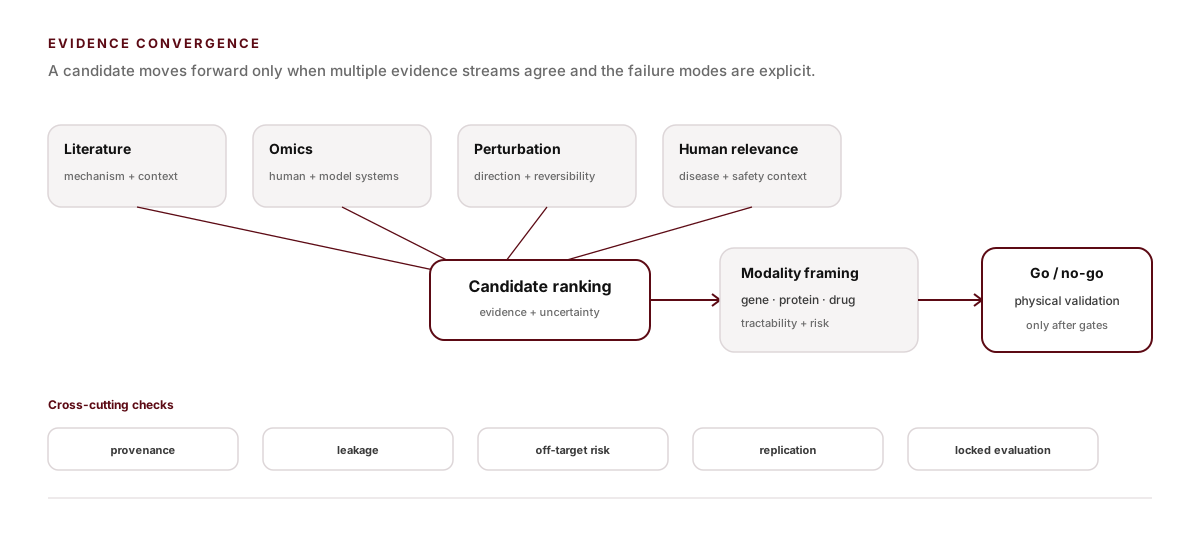
Multi-omic & published evidence → curation & QC → regeneration-associated signals → candidate discovery → cross-dataset / cross-context comparison → mechanistic assessment → modality fit (gene / protein / small molecule) → prioritization → short lead list → future laboratory testing.
Output is a documented shortlist with uncertainties and proposed experiments , not a marketing claim of efficacy.
VB-101 is the gene-therapy program that operationalizes much of this discovery logic for regenerative regulators. Protein & drug discovery generalizes the same rigor to modality choice and non-gene hypotheses. Evidence and ranking decisions should stay traceable to datasets and literature.
CardiAtlas and CardiLearn structure knowledge and models; measurement tools (ElectroTrace, MyoTrace, OptiCell) and HeartTwin/CardiSim stress-test scenarios; CardiEval/CardiBench keep evaluation independent. CardioScore supports cardiotoxicity research workflows on public MEA-style data.
No approved therapy, no patient dosing, no SaMD. Computational prioritization does not replace institutional review, formal toxicology, CMC, or regulatory filings. Delivery, immunogenicity, and off-target effects remain experimental problems after a candidate is shortlisted.
Independent evaluation of prioritization logic, shared public datasets, or diligence discussions: virelion85@gmail.com