Measure → understand → simulate → design. Compute first, lab second.
Cardiovascular disease is a systems problem. Virelion builds computational infrastructure so candidates and scenarios are ranked before wet-lab spend. The working loop is:
Measure (ElectroTrace, MyoTrace, OptiCell) → Understand (CardiAtlas, CardiLearn) → Simulate (CardiSim, HeartTwin) → Evaluate (CardiEval, CardiBench, DCCP) → Design (program-specific search for VB-101 / VB-204).
No pipette until the model survives public and locked evaluation gates , research principle, not a regulatory claim.
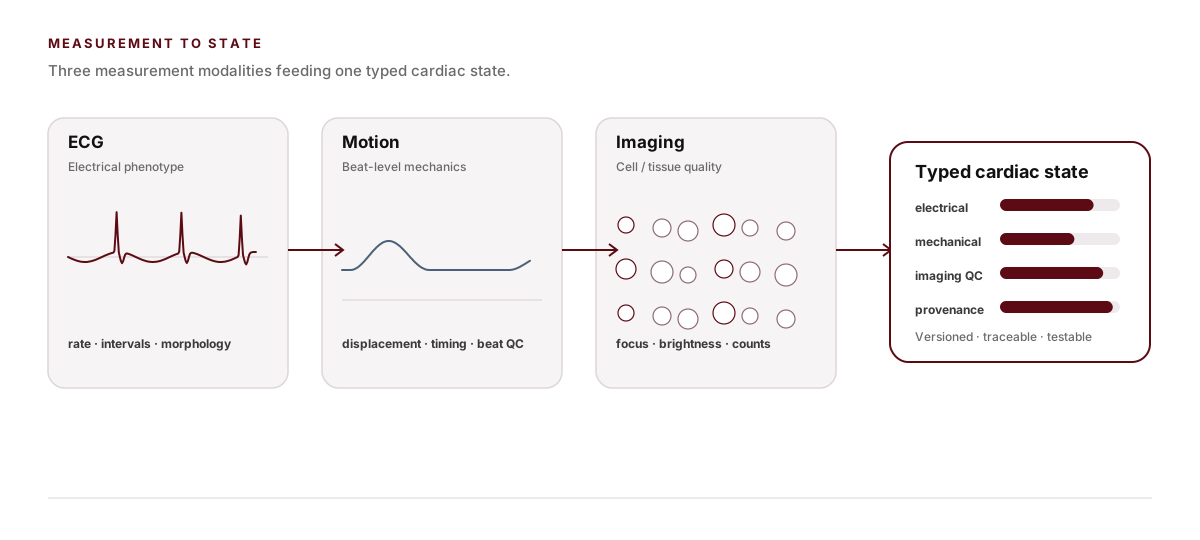
ElectroTrace turns ECG into phenotype labels with leakage-aware ML. MyoTrace extracts motion and beat-level mechanics from video/TIFF. OptiCell runs batch microscopy QC (focus, brightness, cell counts). Together they feed a typed cardiac state rather than ad-hoc spreadsheets.
CardiAtlas structures literature, omics, phenotypes, and evidence provenance. CardiLearn builds representations from multi-modal cardiac data with locked cohorts. CardiEval and CardiBench provide independent evaluation contracts, integrity checks, and versioned benchmarks so predictions stay testable.
CardiSim generates synthetic trajectories under controlled perturbations for software testing and hypothesis generation. HeartTwin is the orchestration layer: native services, CardiBridge messaging, multimodal workflows, and integration-grade checks (including a cardiac digital-twin numerical-equivalence gate in CI). Research infrastructure , not a clinical digital twin.
VB-101 computational gene-therapy discovery (candidate identification). VB-204 engineered cardiac graft concepts (stiffness, vascularization, immune compatibility framing). VB-310 patient-specific digital-twin research (geometry, electrophysiology, what-if scenarios) implemented primarily through HeartTwin.
Measurement and evaluation libraries are public under github.com/Virelion-Biotech. Architecture release: DOI 10.5281/zenodo.22680867.
Beyond terrestrial bench and public datasets, Virelion has a stated future interest in microgravity and extreme-environment physiology as it relates to cardiac regeneration: unloading and remodeling, graft and scaffold performance, and whether computational stacks (HeartTwin and measurement tools) can help interpret limited, high-value flight or analog data.
The same interest extends to space and military medicine settings where cardiac injury, recovery, and decision support under constraint are open research problems. This is directional interest only , not an active mission assignment or product claim.