Patient-specific anatomy, electrophysiology, mechanics, inference, uncertainty, and the credibility requirements behind mechanistic cardiac simulation.
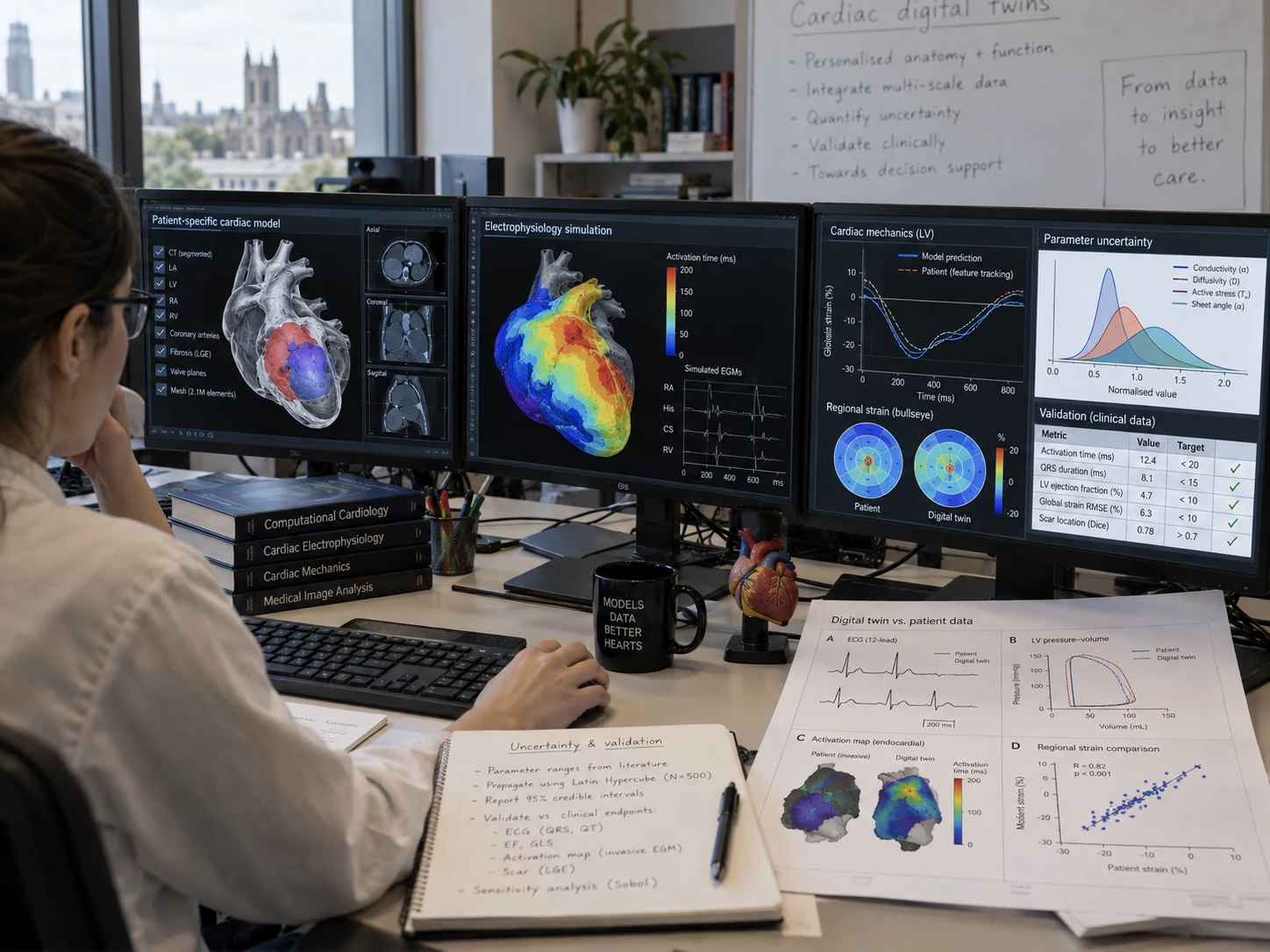
A useful cardiac digital twin is more than a 3D heart rendering. It is a patient-specific model whose anatomy, parameters, and observable outputs are conditioned on measurements from the physical patient. The important distinction is not visual realism; it is whether the model can reproduce relevant physiology, quantify uncertainty, and answer a defined prediction or treatment-planning question.
| Layer | Typical inputs | Model content | Observable outputs |
|---|---|---|---|
| Anatomy | CT, MRI, echo, segmentation | Chambers, wall thickness, scar, fiber orientation, conduction structures | Geometry, volumes, regional tissue maps |
| Electrophysiology | ECG, EGM, activation maps | Ionic or reduced-order cell models + tissue propagation | Activation time, ECG, arrhythmia inducibility |
| Mechanics | Strain, pressure, cine MRI / echo | Passive constitutive law + active tension + boundary conditions | Displacement, strain, pressure–volume behavior |
| Hemodynamics | Flow imaging, pressure, valve data | Lumped, 1D, or 3D flow models | Pressure, flow, ventricular loading |
| Inference | All available observations | Parameter estimation, priors, optimization / Bayesian updating | Patient-specific parameter posterior or calibrated state |
Different model fidelities are appropriate for different questions. Mechanistic electrophysiology often starts from a reaction–diffusion representation, while mechanics solves momentum balance with a constitutive law for myocardium.
Those equations do not make a twin patient-specific. Personalization comes from geometry, tissue characterization, boundary conditions, parameter inference, and validation against observations that were not simply used to fit the model.
Adjust parameters so simulated observables reproduce measured data. A perfect fit can still be non-identifiable if many parameter combinations explain the same observation.
Ask which parameters are actually constrained by the available data. Unidentifiable parameters should not be interpreted as measured patient properties.
Variability in biological or measurement processes that remains even with the correct model.
Uncertainty from incomplete knowledge: model form, parameter choices, segmentation, constitutive assumptions, or missing biology.
A model that reproduces QRS morphology is not automatically validated for ablation planning, mechanics, drug response, or regenerative therapy simulation. Each intended use requires its own verification, validation, and uncertainty analysis, with acceptance criteria defined before looking at the final test set.
Virelion’s HeartTwin is currently an orchestration and integration architecture around typed cardiac states and domain engines. Its scientific credibility depends on the credibility of each component model, the data-to-model interface, parameter inference, provenance, and the intended endpoint. The architecture should make these boundaries explicit rather than hiding them behind a single “twin” label.