Verification, validation, uncertainty quantification, external data, assay reproducibility, and claim-specific evidence gates across the research stack.
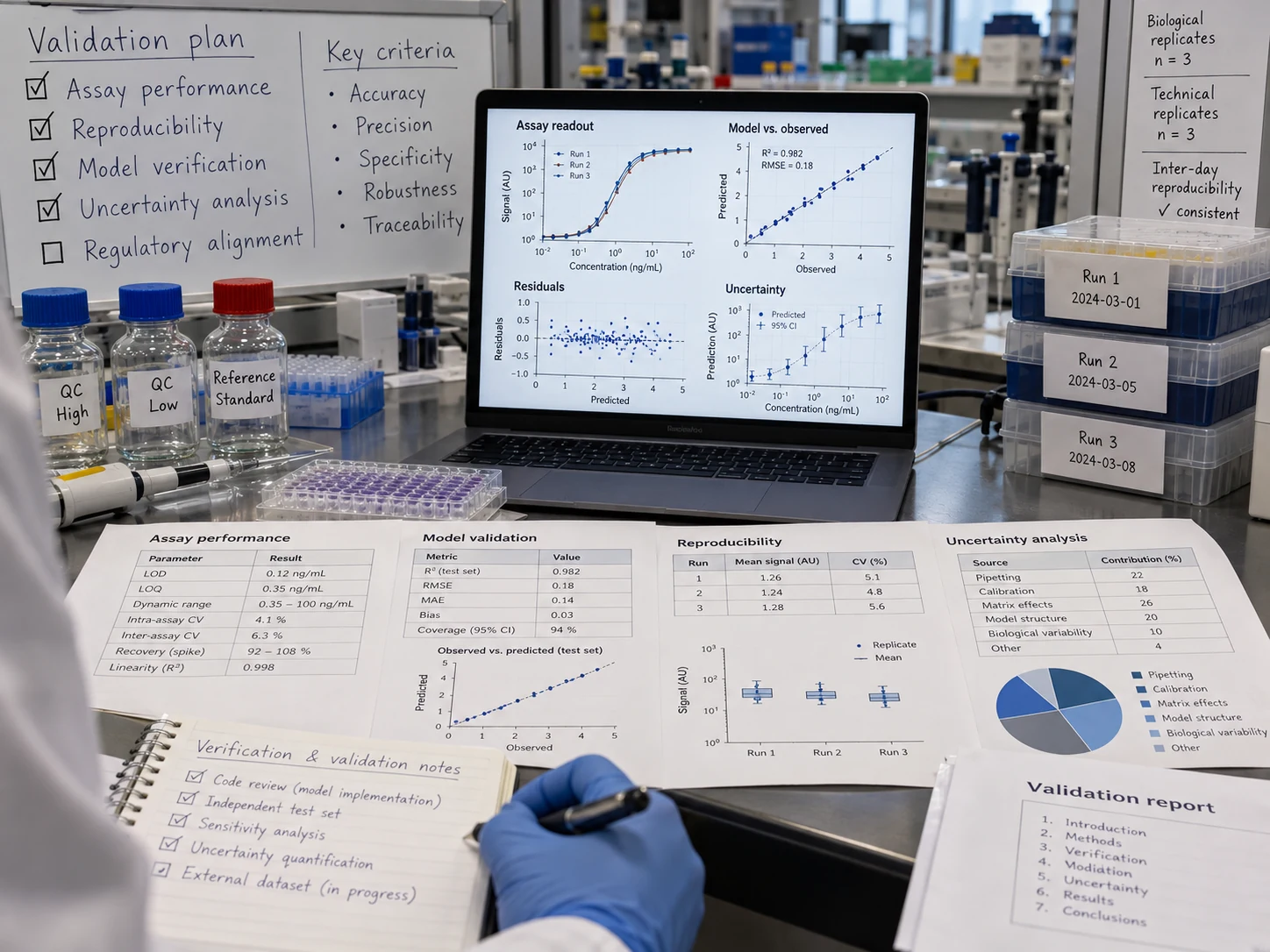
There is no single “validated” state for a model, assay, or therapeutic concept. Credibility is always relative to an intended use. A segmentation model validated for chamber volume is not automatically validated for scar architecture; a digital twin validated for activation time is not automatically credible for drug response; a biomaterial that improves ejection fraction in one model is not automatically regenerative.
| Modality | Minimum credible design | Key metrics | Common invalid shortcut |
|---|---|---|---|
| Wet-lab assay | Biological replicates, controls, randomization / blinding where feasible, predefined exclusions, orthogonal confirmation. | Effect size, uncertainty, batch variance, assay QC. | Treating technical replicates as independent biology. |
| ML classifier | Subject-level splits, untouched external test set, pipeline fit only on training data, transparent missing-data handling. | AUROC / AUPRC as appropriate, calibration, sensitivity / specificity, subgroup performance. | Sample-level leakage or tuning on the test cohort. |
| Mechanistic simulation | Code verification, mesh / time-step convergence, parameter sensitivity, independent physiologic validation. | Endpoint error, parameter uncertainty, predictive interval, qualitative failure modes. | Calling a visually plausible simulation “validated.” |
| Regenerative intervention | Lineage-aware biology + function + electrical safety + durability + relevant disease model. | New cardiomyocytes, scar / remodeling, function, arrhythmia, survival, biodistribution. | Equating one proliferation marker or transient EF change with regeneration. |
Each rung answers a different question. Moving up the ladder should reduce uncertainty about the exact claim, not simply add more experiments.
Model selection stops before the decisive external cohort is opened. That preserves the distinction between development and validation.
Dataset version, code commit, environment, parameters, outputs, and exclusions should be recoverable from manifests rather than reconstructed later.
When possible, validate a biological or modeling claim with a measurement that is not simply another transform of the same input data.
A failed benchmark should narrow the claim or change the model. It should not be hidden behind a different endpoint chosen after the fact.