From multi-omics and perturbation data to a ranked, auditable experimental dossier — with provenance, contradictory evidence, and uncertainty kept visible.
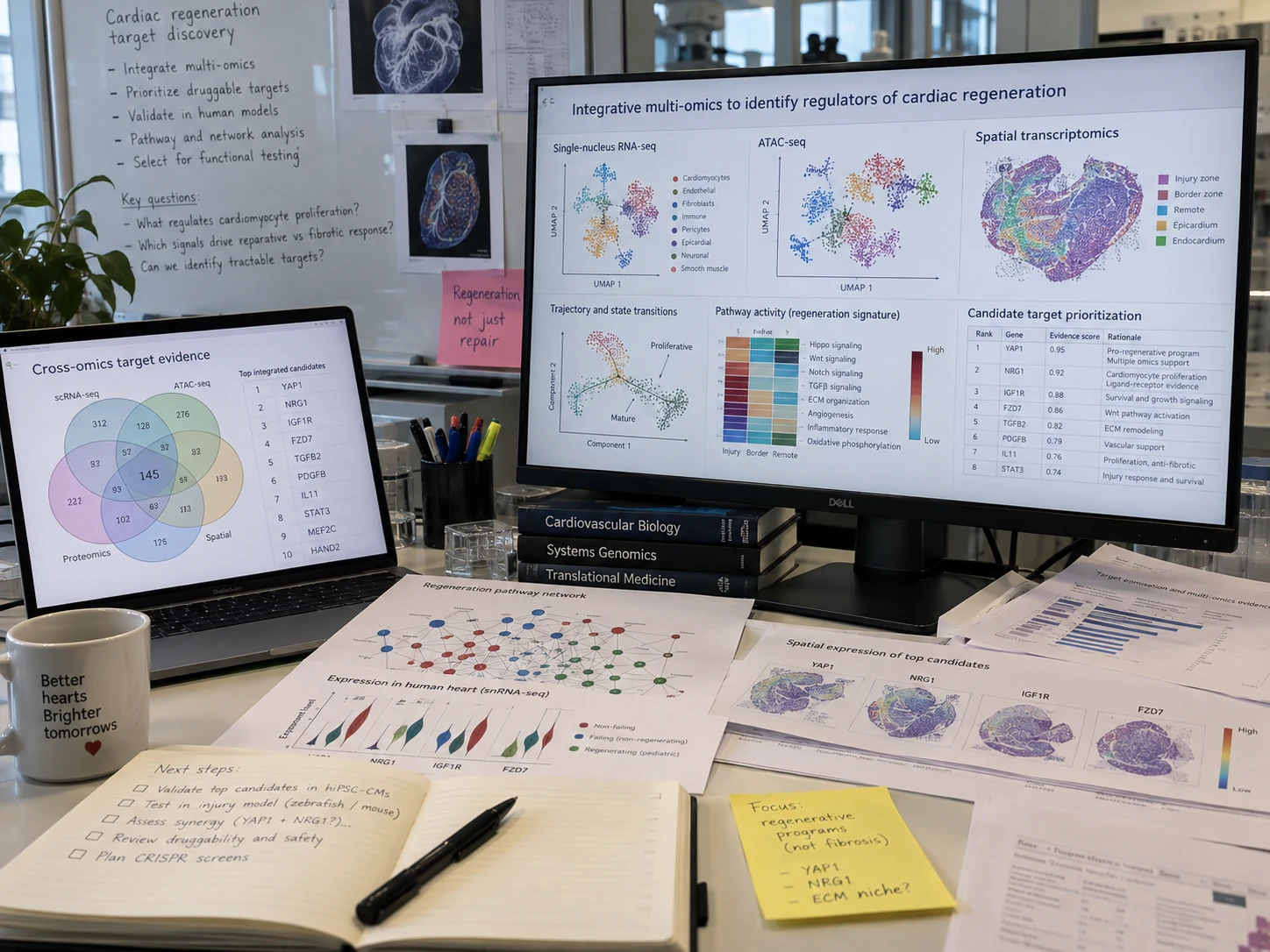
Regenerative biology generates many attractive targets. Most will not survive translation. A defensible discovery system therefore needs to combine orthogonal evidence, penalize contradictory results, preserve provenance, and separate mechanistic support from mere association.
| Evidence | Question | Strength | Failure mode |
|---|---|---|---|
| Human genetics | Does natural perturbation of the target alter cardiac phenotype? | Can support directionality and causal plausibility. | Pleiotropy, weak instruments, population-specific effects. |
| Single-cell / spatial omics | Which cell state expresses or responds to the target, and where? | Resolves cell-type and injury-state specificity. | Batch effects, dissociation bias, correlation without causality. |
| Perturbation data | What changes when the target is manipulated? | Direct experimental test of mechanism. | Model-system dependence, supraphysiologic perturbation. |
| Cross-species evidence | Is the mechanism conserved in regenerative and non-regenerative hearts? | Can reveal core biology and species divergence. | Assuming mouse or zebrafish mechanisms translate unchanged to humans. |
| Literature / prior art | What has been replicated, contradicted, or already attempted? | Context, safety signals, translational history. | Publication bias and circular citation chains. |
| Drug / delivery tractability | Can the mechanism actually be modulated in the right cells and time window? | Connects biology to intervention design. | Strong biology with no practical exposure strategy. |
A target can be pro-regenerative in an immature cardiomyocyte, neutral in a mature adult cardiomyocyte, and harmful in fibroblasts or vascular cells. Discovery therefore needs state-aware evidence: injury phase, cell type, developmental maturity, mechanical context, metabolism, and species.
Single-cell trajectories and time-resolved perturbation can reveal whether a candidate moves cells toward productive regeneration or only transient stress / dedifferentiation.
Five independent evidence types pointing in the same direction are more useful than hundreds of correlated features from one cohort.
Failed replication, species divergence, toxicity, and contradictory perturbations should actively reduce confidence rather than disappear from the dossier.
Candidate-ranking logic should be frozen before final external datasets are opened, otherwise the discovery score can overfit its own evidence base.
CardiAtlas and related stack components are useful when they make this chain auditable: every ranking should be traceable back to its datasets, transformations, model version, and contradictory evidence.